NCERT Class 12 Biology • Chapter 4

Principles of Inheritance and Variation

📄 Source PDF: lebo104.pdf

Read it line by line — each line in the simplest words, with 5 NEET questions, every diagram from the chapter, plus Exceptions, Scientists, Examples, solved Exercises, High-Yield points and 75 PYQs (with the year they appeared).

Intro

Genetics — Inheritance & Variation

1

“Genetics is the branch of biology dealing with inheritance and variation of characters from parents to offspring.”

🧒 Easy Explanation

Genetics is the science of why children look like their parents — and why they are also a little different. ‘Inheritance’ is the passing down of features; ‘variation’ is how much the children differ.

❓ 15 NEET-style questions to master this line
  1. Genetics deals with inheritance and ____ of characters.
    Show answerVariation.
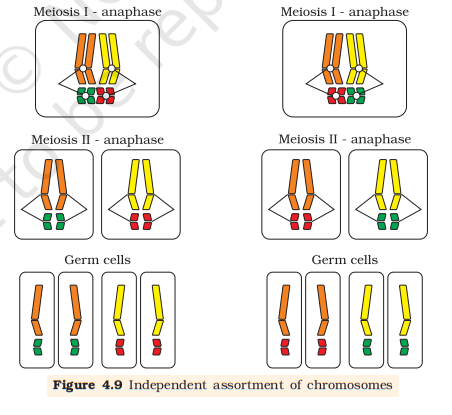
  2. Inheritance is the process by which characters pass from ____ to ____.
    Show answerParent to progeny (offspring).
  3. Inheritance is the basis of ____.
    Show answerHeredity.
  4. Variation is the degree by which progeny ____ from parents.
    Show answerDiffer.
  5. An example of a desirable Indian breed produced by artificial selection of cows is ____.
    Show answerSahiwal (Punjab).
  6. Define inheritance.
    Show answerThe transmission of characters from one generation to the next.
  7. Define variation.
    Show answerDifferences in character among individuals of a species.
  8. Who coined the term 'genetics'?
    Show answerWilliam Bateson (1905).
  9. Heredity is also called?
    Show answerInheritance.
  10. Genetics is a branch of which broader subject?
    Show answerBiology.
  11. Sources of variation in offspring?
    Show answerMutation, recombination and environmental influences.
  12. A character that runs in a family across generations is called?
    Show answerAn inherited (hereditary) character.
  13. The science of heredity and variation was given a formal name when?
    Show answer1905 by Bateson.
  14. Identical twins differ slightly due to?
    Show answerEnvironmental influences (not genetic differences).
  15. Inheritance is governed primarily by?
    Show answerGenes located on chromosomes.
4.1

Mendel's Laws of Inheritance

2

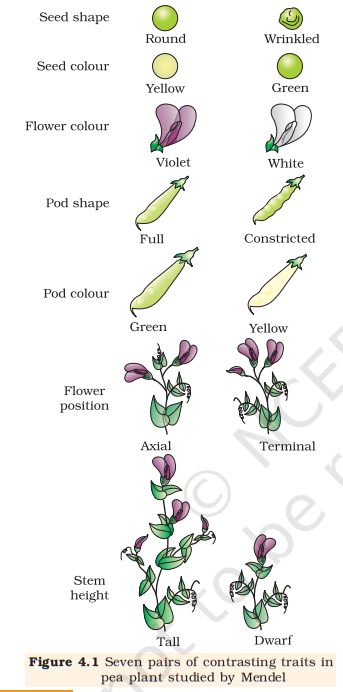
“Gregor Mendel conducted hybridisation experiments on garden pea (Pisum sativum) for seven years (1856–1863) and proposed the laws of inheritance.”

Figure 4.1 Seven pairs of contrasting traits in pea
🧒 Easy Explanation

A monk named Mendel grew pea plants in his garden for 7 years and carefully counted how their features were passed on. He was the first to use maths and big numbers to study biology — that's why his results were trustworthy.

❓ 15 NEET-style questions to master this line
  1. Mendel worked on which plant?
    Show answerGarden pea (Pisum sativum).
  2. For how many years did Mendel conduct his experiments?
    Show answerSeven years (1856–1863).
  3. Mendel was the first to apply ____ analysis to biology.
    Show answerStatistical / mathematical.
  4. Why were Mendel's results credible?
    Show answerLarge sampling size and confirmation over successive generations.
  5. A line that shows stable trait expression over generations of self-pollination is called ____.
    Show answerTrue-breeding line.
  6. Mendel is often called?
    Show answerThe Father of Genetics.
  7. Where did Mendel carry out his experiments?
    Show answerIn his monastery garden at Brünn (modern Brno).
  8. Why did Mendel choose Pisum sativum?
    Show answerShort life cycle, easy hybridisation, several true-breeding varieties with contrasting traits, bisexual flowers that normally self-pollinate.
  9. Time span of Mendel's pea experiments?
    Show answerSeven years, 1856–1863.
  10. Year Mendel published his findings?
    Show answer1866 (Verhandlungen des naturforschenden Vereins in Brünn).
  11. Why were Mendel's results overlooked initially?
    Show answerLack of statistical/mathematical approach in biology at the time and limited circulation of his journal.
  12. In which year were Mendel's laws rediscovered?
    Show answer1900 (independently by de Vries, Correns and von Tschermak).
  13. Mendel applied which mathematics to his data?
    Show answerStatistics — large samples and ratio analysis.
  14. Two types of pollination practised in pea?
    Show answerSelf-pollination (natural) and cross-pollination (artificially in experiments).
  15. Mendel's monastery was in which country?
    Show answerAustria-Hungary (now Czech Republic).
3

“Mendel selected 14 true-breeding pea varieties as 7 pairs, each pair similar except for one character with two contrasting traits (e.g. tall/dwarf, round/wrinkled seeds, yellow/green seeds).”

🧒 Easy Explanation

He picked pea plants that came in clear opposite versions — tall vs short, round vs wrinkled seeds, and so on. Seven such opposite pairs. Clear opposites make differences easy to count.

📋 Quick referenceSeven Contrasting Traits Studied by Mendel in Pea

#CharacterDominant traitRecessive trait
1Stem heightTallDwarf
2Flower colourVioletWhite
3Flower positionAxialTerminal
4Pod shapeInflatedConstricted
5Pod colourGreenYellow
6Seed shapeRoundWrinkled
7Seed colourYellowGreen

14 true-breeding varieties — 2 contrasting forms × 7 characters. Memorise the dominant column for instant recall in NEET MCQs.

❓ 15 NEET-style questions to master this line
  1. How many pairs of contrasting traits did Mendel study?
    Show answerSeven.
  2. Name two contrasting traits of pea seeds Mendel used.
    Show answerRound/wrinkled shape; yellow/green colour.
  3. Flower colour traits studied: violet / ____.
    Show answerWhite.
  4. Pod shape traits: inflated / ____.
    Show answerConstricted.
  5. Flower position traits: axial / ____.
    Show answerTerminal.
  6. How many pairs of contrasting traits did Mendel choose?
    Show answerSeven pairs.
  7. Name two contrasting traits involving the seed.
    Show answerRound/wrinkled seed shape; yellow/green seed colour.
  8. Contrasting traits of pod shape?
    Show answerInflated (constricted) / constricted pod.
  9. Contrasting traits of pod colour?
    Show answerGreen / yellow pod.
  10. Contrasting traits of flower colour?
    Show answerViolet / white.
  11. Contrasting traits of flower position?
    Show answerAxial / terminal.
  12. Contrasting traits of stem length?
    Show answerTall / dwarf.
  13. Total number of true-breeding varieties used by Mendel?
    Show answerFourteen (7 pairs).
  14. What does 'true-breeding' mean?
    Show answerA line that, upon self-pollination, gives offspring identical to the parent for the chosen trait over several generations.
  15. Which trait pair shows clear dominance in seed colour?
    Show answerYellow (dominant) over green.
4.2

Inheritance of One Gene (Monohybrid Cross)

4

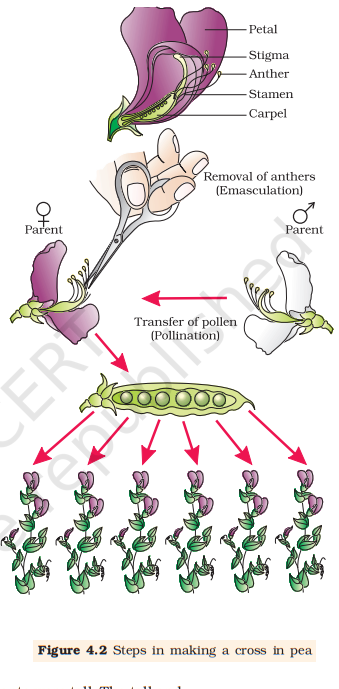
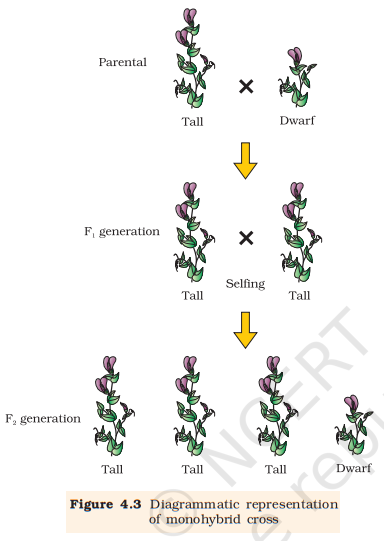
“When Mendel crossed a true-breeding tall plant with a dwarf, all F1 plants were tall; on self-pollinating the F1, the F2 showed tall and dwarf in a 3:1 ratio, with no blending.”

Figure 4.2 Steps in making a cross in pea
Figure 4.3 Monohybrid cross
🧒 Easy Explanation

He crossed a tall pea with a short pea. ALL the children (F1) were tall — the shortness seemed to vanish. But when those tall children made their own seeds, shortness came back! Out of every 4 grandchildren, 3 were tall and 1 short. The traits never mixed into ‘medium’.

❓ 15 NEET-style questions to master this line
  1. In the monohybrid cross, F1 plants were all ____.
    Show answerTall.
  2. The F2 phenotypic ratio (tall:dwarf) was ____.
    Show answer3:1.
  3. F1 is also called the ____ generation.
    Show answerFirst filial (F1).
  4. Did the tall and dwarf traits blend?
    Show answerNo — no blending; offspring were either tall or dwarf.
  5. The dwarf trait reappeared in which generation?
    Show answerF2.
  6. F1 phenotype of Mendel's tall × dwarf cross?
    Show answerAll tall.
  7. F1 genotype?
    Show answerAll heterozygous Tt.
  8. F2 phenotypic ratio?
    Show answer3 tall : 1 dwarf.
  9. F2 genotypic ratio?
    Show answer1 TT : 2 Tt : 1 tt.
  10. Why didn't blending occur in F1 plants?
    Show answerAlleles remain distinct and segregate during gamete formation — no blending.
  11. Fraction of F2 that is homozygous?
    Show answer1/2 (TT and tt together).
  12. Fraction of F2 that breeds true-tall on self-pollination?
    Show answer1/4 (only TT).
  13. Fraction of F2 dwarfs that breed true?
    Show answerAll dwarfs (tt are homozygous).
  14. Probability that a randomly chosen tall F2 plant is heterozygous?
    Show answer2/3.
  15. Name of the type of cross showing this 3:1?
    Show answerMonohybrid cross.
5

“Mendel called the heritable units ‘factors’ (now genes). Genes for a pair of contrasting traits are alleles. Genotype is the genetic make-up (TT, Tt, tt); phenotype is the appearance (tall/dwarf).”

🧒 Easy Explanation

Mendel said something tiny is passed in the gametes — he called them ‘factors’; today we call them genes. The two versions of a gene (like T for tall and t for dwarf) are ‘alleles’. The hidden code is the genotype; the look is the phenotype.

❓ 15 NEET-style questions to master this line
  1. Mendel's ‘factors’ are today called ____.
    Show answerGenes.
  2. Different forms of the same gene are called ____.
    Show answerAlleles.
  3. TT and tt are examples of ____ (homozygous/heterozygous).
    Show answerHomozygous.
  4. Tt is ____.
    Show answerHeterozygous.
  5. The genetic make-up (TT/Tt/tt) is the ____; the appearance is the ____.
    Show answerGenotype; phenotype.
  6. Modern name for Mendel's 'factors'?
    Show answerGenes.
  7. Define allele.
    Show answerAlternative form of the same gene.
  8. How many alleles does a diploid organism have per gene?
    Show answerTwo (one on each homologous chromosome).
  9. Genotype of a homozygous dominant tall pea?
    Show answerTT.
  10. Genotype of a heterozygous tall pea?
    Show answerTt.
  11. Genotype of a dwarf pea?
    Show answertt.
  12. Define phenotype.
    Show answerThe observable physical characteristics of an organism.
  13. Genotype is the genetic constitution; phenotype is the?
    Show answerOutward appearance/expression.
  14. Can two plants with the same phenotype have different genotypes?
    Show answerYes — TT and Tt both look tall.
  15. Term for an organism with two identical alleles?
    Show answerHomozygous.
6

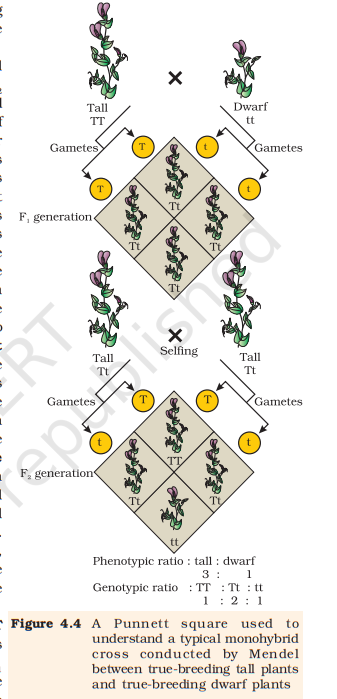
“A Punnett square (devised by Reginald C. Punnett) predicts offspring genotypes. A monohybrid F2 gives a genotypic ratio 1:2:1 (TT:Tt:tt) and a phenotypic ratio 3:1.”

Figure 4.4 Punnett square for a monohybrid cross
🧒 Easy Explanation

The Punnett square is a simple grid that lets you predict the babies from a cross. For one gene, the F2 grid gives genes in 1:2:1 (1 TT, 2 Tt, 1 tt) but the looks come out 3 tall : 1 dwarf.

❓ 15 NEET-style questions to master this line
  1. The grid used to predict offspring genotypes is the ____.
    Show answerPunnett square.
  2. Who developed the Punnett square?
    Show answerReginald C. Punnett.
  3. Monohybrid F2 genotypic ratio?
    Show answer1:2:1 (TT:Tt:tt).
  4. Monohybrid F2 phenotypic ratio?
    Show answer3:1.
  5. In Tt, which trait is expressed and why?
    Show answerT (tall) — it is dominant over t.
  6. Who devised the Punnett square?
    Show answerReginald C. Punnett.
  7. Why is the Punnett square used?
    Show answerTo predict offspring genotypes and phenotypes from a cross.
  8. Monohybrid F2 phenotypic ratio?
    Show answer3 : 1.
  9. Monohybrid F2 genotypic ratio?
    Show answer1 : 2 : 1.
  10. Probability of getting tt offspring from Tt × Tt?
    Show answer1/4 (25%).
  11. Probability of dominant phenotype from Tt × Tt?
    Show answer3/4 (75%).
  12. Total number of gametes from Tt × Tt?
    Show answerTwo unique gamete types from each parent (T and t).
  13. Number of boxes in the Punnett square for a monohybrid cross?
    Show answerFour.
  14. Number of boxes for a dihybrid cross?
    Show answerSixteen (4 × 4).
  15. Punnett square is mainly used for?
    Show answerVisualising inheritance patterns mathematically.
7

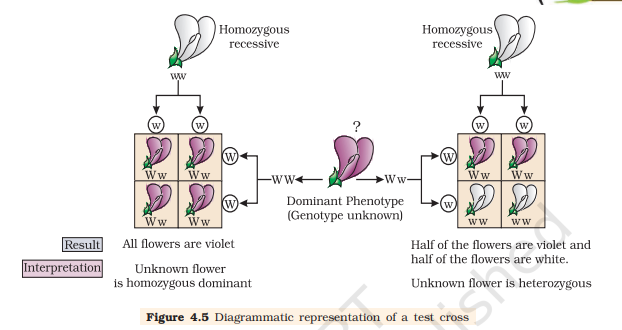
“A test cross crosses an individual showing the dominant phenotype (unknown genotype) with the homozygous recessive parent, to determine the unknown genotype.”

Figure 4.5 A test cross
🧒 Easy Explanation

If a tall plant could be TT or Tt, how do you tell? Cross it with a short (tt) plant. If any short babies appear, the tall one was secretly Tt. This detective cross is the ‘test cross’.

❓ 15 NEET-style questions to master this line
  1. A test cross is made with which parent?
    Show answerHomozygous recessive parent.
  2. Purpose of a test cross?
    Show answerTo determine the unknown genotype of a dominant-phenotype individual.
  3. Test cross of Tt × tt gives phenotypic ratio ____.
    Show answer1:1.
  4. If a test cross gives all dominant offspring, the tested parent was ____.
    Show answerHomozygous (TT).
  5. Test cross ratio of a heterozygote is ____ (genotypic = phenotypic).
    Show answer1:1.
  6. Purpose of a test cross?
    Show answerTo determine the genotype of an organism showing the dominant phenotype.
  7. With which genotype is the unknown crossed?
    Show answerHomozygous recessive.
  8. If a tall pea is TT, what does the test cross yield?
    Show answerAll tall offspring.
  9. If a tall pea is Tt, what does the test cross yield?
    Show answer1 tall : 1 dwarf (50:50).
  10. A test cross is sometimes called?
    Show answerBackcross to recessive parent.
  11. Why use a homozygous recessive parent for test cross?
    Show answerIt contributes only recessive alleles, so offspring directly reveal the gametes (alleles) of the unknown.
  12. Test cross is a quick way to check?
    Show answerHeterozygosity in a dominant phenotype.
  13. Test cross ratio of 1:1 indicates the unknown is?
    Show answerHeterozygous (Tt).
  14. Test cross with all dominant phenotype indicates the unknown is?
    Show answerHomozygous dominant (TT).
  15. Symbol commonly used for test cross?
    Show answerTT or Tt × tt notation.
8

“Mendel's First Law (Law of Dominance): characters are controlled by factors occurring in pairs; in a dissimilar pair one factor dominates the other. Second Law (Law of Segregation): alleles separate during gamete formation so each gamete gets only one allele.”

🧒 Easy Explanation

Two big rules. (1) Law of Dominance: genes come in pairs and one can mask the other. (2) Law of Segregation: when gametes form, the two alleles split up so each egg or pollen carries just one.

❓ 15 NEET-style questions to master this line
  1. Mendel's First Law is the Law of ____.
    Show answerDominance.
  2. Mendel's Second Law is the Law of ____.
    Show answerSegregation.
  3. Law of Segregation: each gamete receives ____ allele(s).
    Show answerOnly one.
  4. Which law explains the 3:1 F2 ratio?
    Show answerLaw of Dominance.
  5. Alleles segregate during ____ formation (by meiosis).
    Show answerGamete.
  6. State the Law of Dominance.
    Show answerWhen two contrasting alleles are present, only one (the dominant) expresses in the F1.
  7. State the Law of Segregation.
    Show answerThe two alleles of a gene separate during gamete formation so that each gamete carries only one allele.
  8. During which cellular event does segregation occur?
    Show answerAnaphase I of meiosis (separation of homologous chromosomes).
  9. Each gamete is haploid for each gene because of?
    Show answerMendel's Law of Segregation.
  10. Law of Dominance applies to which generation?
    Show answerF1 generation primarily.
  11. Does the Law of Dominance always hold?
    Show answerNo — incomplete dominance and co-dominance are exceptions.
  12. In Tt parent, percentage of T-carrying gametes?
    Show answer50%.
  13. Why does a recessive trait reappear in F2?
    Show answerBecause alleles segregate — F1 (Tt) produces gametes carrying t, and tt offspring reappear in F2.
  14. Mendel's First Law is also called?
    Show answerLaw of Dominance.
  15. Mendel's Second Law is also called?
    Show answerLaw of Segregation or Law of Purity of Gametes.
9

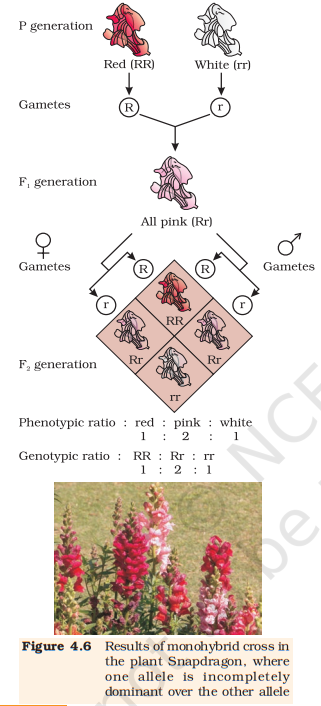
“Incomplete dominance: in snapdragon (Antirrhinum), red (RR) × white (rr) gives pink (Rr) F1; F2 ratio is 1 red : 2 pink : 1 white — the phenotypic ratio equals the genotypic ratio (1:2:1).”

Figure 4.6 Incomplete dominance in Snapdragon
🧒 Easy Explanation

Sometimes neither version fully wins. Red flower × white flower gives PINK babies (a blend!). Here the looks ratio (1:2:1) matches the gene ratio, because the heterozygote looks different from both parents.

❓ 15 NEET-style questions to master this line
  1. Incomplete dominance is shown by which plant's flower colour?
    Show answerSnapdragon (Antirrhinum).
  2. RR (red) × rr (white) F1 is ____.
    Show answerPink (Rr).
  3. F2 phenotypic ratio in incomplete dominance?
    Show answer1:2:1 (red:pink:white).
  4. In incomplete dominance, phenotypic ratio ____ genotypic ratio.
    Show answerEquals.
  5. Why is Rr pink and not red?
    Show answerR is not completely dominant over r.
  6. Plant example of incomplete dominance?
    Show answerSnapdragon (Antirrhinum).
  7. Phenotype of Rr in snapdragon?
    Show answerPink.
  8. F2 phenotypic ratio in incomplete dominance?
    Show answer1 red : 2 pink : 1 white.
  9. F2 genotypic ratio in incomplete dominance?
    Show answer1 : 2 : 1.
  10. Why does the phenotypic ratio equal the genotypic ratio?
    Show answerBecause heterozygote has a distinct intermediate phenotype.
  11. Incomplete dominance shows that dominance is?
    Show answerNot absolute / not always complete.
  12. Is there blending of alleles in incomplete dominance?
    Show answerNo — alleles remain intact; only their phenotypic expression is intermediate.
  13. Another plant example of incomplete dominance?
    Show answerMirabilis jalapa (4 o'clock plant).
  14. Animal example of incomplete dominance?
    Show answerAndalusian fowl (black × white → blue-grey).
  15. Does selfing F1 (Rr) recover red and white?
    Show answerYes — F2 shows 1:2:1.
10

“Co-dominance: both alleles express together. Human ABO blood groups (gene I, alleles IA, IB, i) show this — IA and IB are co-dominant (AB blood), both dominant over i. This is also an example of multiple alleles.”

🧒 Easy Explanation

In co-dominance both versions show up at once. Blood group AB is the classic case: the A-gene and B-gene both make their sugar, so you get both. Blood groups also show ‘multiple alleles’ — three versions (IA, IB, i) of one gene.

❓ 15 NEET-style questions to master this line
  1. ABO blood group is controlled by gene ____.
    Show answerI.
  2. Which alleles are co-dominant?
    Show answerIA and IB (giving AB blood).
  3. Allele i is ____ to both IA and IB.
    Show answerRecessive.
  4. Genotype of blood group O is ____.
    Show answerii.
  5. ABO blood grouping illustrates co-dominance and ____ alleles.
    Show answerMultiple.
  6. Gene symbol for ABO blood group?
    Show answerI.
  7. Alleles of the ABO gene?
    Show answerI^A, I^B and i.
  8. Phenotype of I^A I^B?
    Show answerBlood group AB.
  9. Why is ABO an example of multiple alleles?
    Show answerBecause the gene I has three alleles (I^A, I^B, i).
  10. Genotype(s) of blood group A?
    Show answerI^A I^A or I^A i.
  11. Genotype(s) of blood group B?
    Show answerI^B I^B or I^B i.
  12. Genotype of blood group O?
    Show answerii.
  13. Is i dominant, recessive or co-dominant?
    Show answerRecessive to both I^A and I^B.
  14. Universal donor blood group?
    Show answerO.
  15. Universal recipient blood group?
    Show answerAB.
11

“Dominance is not an autonomous property of a gene: e.g. starch synthesis gene in pea (alleles B, b) — round vs wrinkled seed shows dominance, but starch-grain SIZE in Bb is intermediate (incomplete dominance). So the same gene can show different dominance for different phenotypes.”

🧒 Easy Explanation

Whether a gene ‘wins’ depends on what you look at. The pea seed gene looks fully dominant for shape (round), but if you measure the starch grains inside, the heterozygote is in-between. Same gene, different answer.

❓ 15 NEET-style questions to master this line
  1. Dominance is/​is not an autonomous feature of a gene?
    Show answerIs NOT autonomous.
  2. Starch synthesis in pea is controlled by alleles ____.
    Show answerB and b.
  3. BB seeds are ____; bb seeds are ____.
    Show answerRound; wrinkled.
  4. Starch-grain size in Bb shows ____ dominance.
    Show answerIncomplete.
  5. Dominance depends on the gene product and the ____ examined.
    Show answerPhenotype.
  6. Dominance depends on?
    Show answerThe gene product and the specific phenotype examined.
  7. In pea, alleles for seed shape are?
    Show answerB (round) and b (wrinkled).
  8. What product does the B allele encode?
    Show answerA functional starch-synthesising enzyme.
  9. Phenotype of Bb seed (shape)?
    Show answerRound (B dominant).
  10. Phenotype of Bb seed (starch grain size)?
    Show answerIntermediate (incomplete dominance for grain size).
  11. This proves that dominance is a function of?
    Show answerThe specific gene product and the trait observed, not the gene per se.
  12. Wrinkled seed phenotype is due to?
    Show answerDefective starch-branching enzyme.
  13. Same gene showing dominance for one trait and incomplete dominance for another is an example of?
    Show answerContext-dependent dominance.
  14. Round-seeded pea has more starch because?
    Show answerFunctional enzyme produces more amylopectin.
  15. Wrinkled seed shows loss of water and starch because?
    Show answerReduced osmotic activity due to defective enzyme.
4.3

Inheritance of Two Genes (Dihybrid Cross)

12

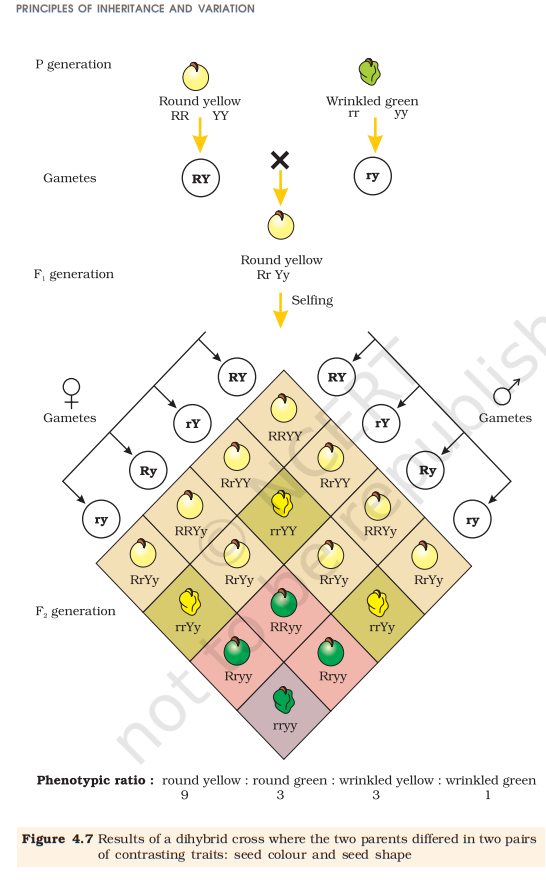
“In a dihybrid cross (RRYY round-yellow × rryy wrinkled-green), F1 are all round-yellow (RrYy); F2 shows the four phenotypes in a 9:3:3:1 ratio.”

Figure 4.7 Dihybrid cross (seed colour & shape)
🧒 Easy Explanation

Now track TWO features at once — seed shape and seed colour. The F1 are all round-yellow. The grandchildren (F2) come in four kinds in the famous ratio 9:3:3:1.

❓ 15 NEET-style questions to master this line
  1. Dihybrid F2 phenotypic ratio?
    Show answer9:3:3:1.
  2. F1 of RRYY × rryy is ____.
    Show answerRrYy (round, yellow).
  3. How many gamete types does RrYy produce?
    Show answerFour (RY, Ry, rY, ry).
  4. In F2 of a dihybrid cross, how many phenotypes appear?
    Show answerFour.
  5. Round/wrinkled and yellow/green each still segregate in a ____ ratio.
    Show answer3:1.
  6. Phenotype of F1 in RrYy?
    Show answerRound, yellow seeds.
  7. Number of phenotypes in F2 of a dihybrid cross?
    Show answerFour.
  8. F2 phenotypic ratio in dihybrid cross?
    Show answer9 : 3 : 3 : 1.
  9. Component '9' refers to?
    Show answerRound-yellow (both dominant traits).
  10. Component '1' refers to?
    Show answerWrinkled-green (both recessive).
  11. Total number of gamete types from RrYy?
    Show answerFour — RY, Ry, rY, ry.
  12. Probability of getting rryy offspring from RrYy × RrYy?
    Show answer1/16.
  13. F2 genotypic ratio in a dihybrid cross?
    Show answer9 distinct genotypes in ratio 1:2:1:2:4:2:1:2:1.
  14. If the genes were linked, would 9:3:3:1 still hold?
    Show answerNo — deviations occur because of linkage.
  15. Dihybrid cross supports which law?
    Show answerLaw of Independent Assortment (Mendel's Third Law).
13

“Law of Independent Assortment (Mendel's Third Law): when two pairs of traits are combined in a hybrid, the segregation of one pair is independent of the other pair.”

🧒 Easy Explanation

This law says the two features are sorted into gametes independently — seed colour doesn't care what seed shape is doing. That independence is what creates the new combinations.

❓ 15 NEET-style questions to master this line
  1. Mendel's Law of Independent Assortment is his ____ law.
    Show answerThird.
  2. Independent assortment: segregation of one pair is ____ of the other.
    Show answerIndependent.
  3. Independent assortment produces ____ combinations of traits.
    Show answerNew (recombinant).
  4. The 9:3:3:1 ratio results from which law?
    Show answerLaw of Independent Assortment.
  5. Independent assortment occurs during which division?
    Show answerMeiosis (gamete formation).
  6. State Mendel's Third Law.
    Show answerWhen two pairs of traits are combined in a hybrid, segregation of one pair is independent of the other pair.
  7. Independent assortment occurs during?
    Show answerMetaphase I of meiosis (random orientation of bivalents).
  8. If two genes are on the same chromosome, do they assort independently?
    Show answerGenerally no — they tend to be linked.
  9. Number of gamete types possible from RrYy?
    Show answerFour equally frequent: RY, Ry, rY, ry (each 25%).
  10. Independent assortment explains what feature of inheritance?
    Show answerNew (recombinant) combinations of parental traits.
  11. Mendel's Third Law is observed only when?
    Show answerGenes are on different chromosomes (or far apart on the same chromosome).
  12. Without independent assortment, what would dihybrid F2 ratio look like?
    Show answerDifferent from 9:3:3:1 — closer to parental ratios.
  13. Independent assortment increases?
    Show answerGenetic variation in offspring.
  14. Mendel's Third Law was demonstrated using?
    Show answerDihybrid cross in pea (round-yellow × wrinkled-green).
  15. Probability of obtaining rrYy genotype in F2?
    Show answer2/16 = 1/8.
14

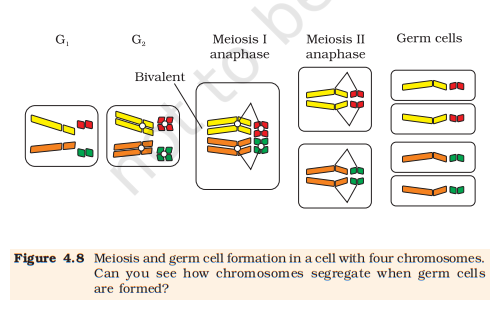
“Chromosomal Theory of Inheritance (Sutton & Boveri, 1902): chromosomes (and genes) occur in pairs, segregate at gamete formation, and assort independently — paralleling Mendel's factors. Mendel's work was rediscovered in 1900 by de Vries, Correns and von Tschermak.”

Figure 4.8 Meiosis & germ-cell formation
Figure 4.9 Independent assortment of chromosomes
🧒 Easy Explanation

Years later, scientists saw chromosomes pairing and separating exactly like Mendel's ‘factors’. Sutton and Boveri put the two ideas together: genes ride on chromosomes. (Mendel's forgotten work was rediscovered in 1900 by three scientists.)

❓ 15 NEET-style questions to master this line
  1. Who proposed the Chromosomal Theory of Inheritance?
    Show answerWalter Sutton and Theodore Boveri (1902).
  2. Genes are located on ____.
    Show answerChromosomes.
  3. Mendel's work was rediscovered in 1900 by ____.
    Show answerde Vries, Correns and von Tschermak.
  4. Two alleles of a gene lie on ____ sites of homologous chromosomes.
    Show answerHomologous.
  5. Chromosomes, like genes, occur in ____.
    Show answerPairs.
  6. Who proposed the Chromosomal Theory of Inheritance?
    Show answerWalter Sutton and Theodor Boveri (1902).
  7. Key insight of the Chromosomal Theory?
    Show answerChromosomes are the physical carriers of Mendel's hereditary factors.
  8. What did Sutton observe in grasshoppers?
    Show answerChromosomes occur in pairs and segregate at meiosis — paralleling Mendel's factors.
  9. Mendel's work was rediscovered in?
    Show answer1900.
  10. Three scientists who rediscovered Mendel's work?
    Show answerHugo de Vries, Carl Correns, Erich von Tschermak.
  11. What do paired alleles correspond to physically?
    Show answerTwo homologous chromosomes.
  12. Mendel's segregation parallels which meiotic event?
    Show answerSeparation of homologous chromosomes in Anaphase I.
  13. Independent assortment parallels what chromosomal event?
    Show answerRandom orientation of bivalents at Metaphase I.
  14. In what year did Sutton publish his theory?
    Show answer1902.
  15. Chromosomal Theory provided the physical basis for?
    Show answerMendel's laws.
15

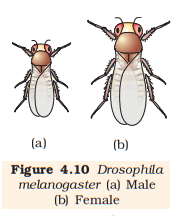
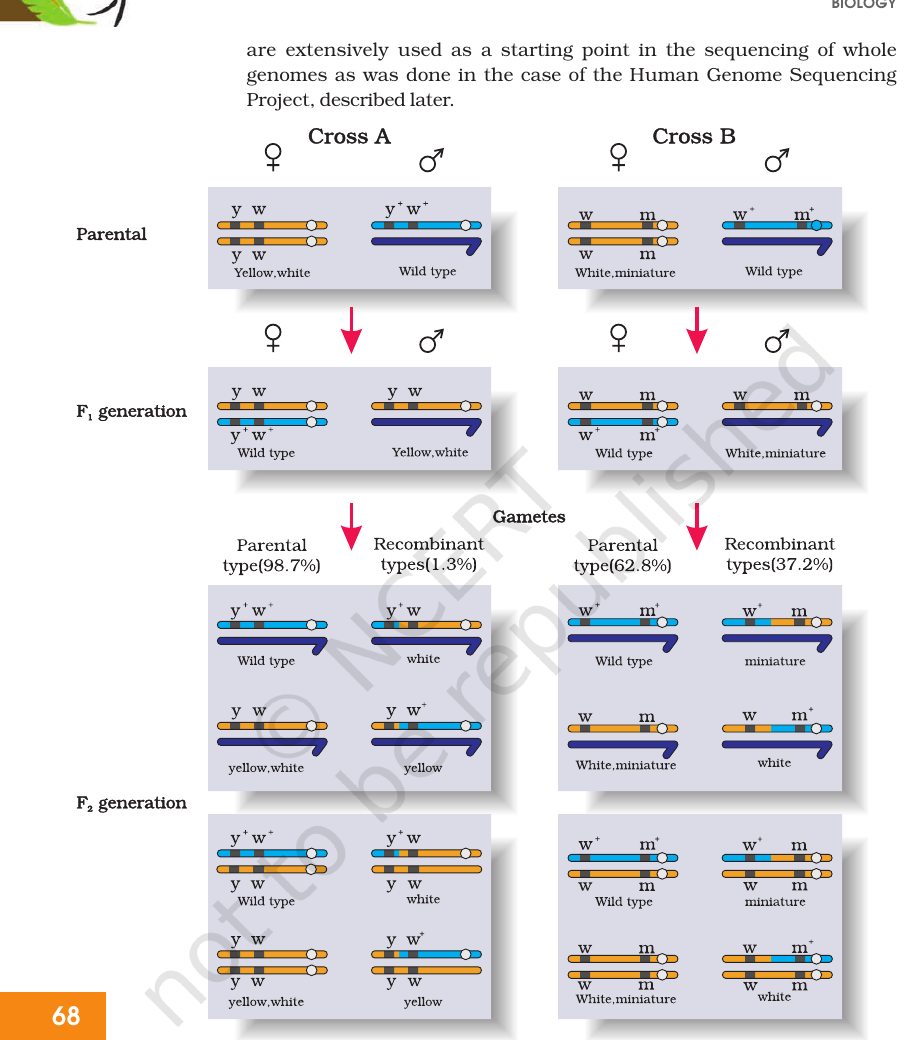
“Thomas Hunt Morgan verified the chromosomal theory using fruit flies (Drosophila melanogaster). Genes on the same chromosome are linked and do not assort independently, deviating from 9:3:3:1; non-parental combinations arise by recombination.”

Figure 4.10 Drosophila (a) male (b) female
Figure 4.11 Linkage — two dihybrid crosses by Morgan
🧒 Easy Explanation

Morgan used tiny fruit flies (they breed fast). He found that genes sitting on the SAME chromosome travel together — that's ‘linkage’ — so they break Mendel's 9:3:3:1. Sometimes they swap, making new mixes — that's ‘recombination’.

❓ 15 NEET-style questions to master this line
  1. Morgan worked with which organism?
    Show answerDrosophila melanogaster (fruit fly).
  2. Genes on the same chromosome that stay together show ____.
    Show answerLinkage.
  3. Generation of non-parental gene combinations is called ____.
    Show answerRecombination.
  4. Linked genes deviate from which ratio?
    Show answer9:3:3:1.
  5. Tightly linked genes show ____ recombination frequency.
    Show answerLow.
  6. Who used Drosophila to verify the Chromosomal Theory?
    Show answerThomas Hunt Morgan.
  7. Why was Drosophila a great experimental organism?
    Show answerSmall size, short life cycle (~2 weeks), produces many offspring, easily grown, clearly distinguishable sexes.
  8. What is linkage?
    Show answerTendency of genes located on the same chromosome to be inherited together.
  9. What gives rise to non-parental combinations?
    Show answerRecombination (crossing over during meiosis).
  10. Two genes that show 50% recombination are?
    Show answerUnlinked (or so far apart they assort independently).
  11. Linked genes deviate from which Mendelian ratio?
    Show answer9:3:3:1 in dihybrid cross.
  12. Morgan received the Nobel Prize in?
    Show answer1933 (Physiology or Medicine).
  13. Drosophila has how many pairs of chromosomes?
    Show answerFour pairs (3 autosomes + 1 sex).
  14. The phenomenon of exchange of chromosomal segments is called?
    Show answerCrossing over.
  15. Recombinant offspring are produced because of?
    Show answerCrossing over between homologous chromosomes.
16

“Alfred Sturtevant used recombination frequency between gene pairs to measure the distance between genes and map their positions on the chromosome (genetic maps).”

🧒 Easy Explanation

Morgan's student Sturtevant had a clever idea: the more often two genes swap, the farther apart they must be. He used this to draw the first ‘maps’ showing where genes sit on a chromosome.

❓ 15 NEET-style questions to master this line
  1. Who first mapped gene positions using recombination frequency?
    Show answerAlfred Sturtevant.
  2. Recombination frequency is a measure of ____ between genes.
    Show answerDistance.
  3. White and yellow genes showed ____ % recombination (tight linkage).
    Show answer1.3%.
  4. White and miniature-wing showed ____ % recombination.
    Show answer37.2%.
  5. Genetic maps are used as a starting point for ____ projects.
    Show answerGenome sequencing.
  6. Who used recombination frequency to make genetic maps?
    Show answerAlfred Sturtevant (Morgan's student).
  7. Unit of genetic distance?
    Show answercentimorgan (cM) or map unit.
  8. One map unit (1 cM) corresponds to?
    Show answer1% recombination frequency.
  9. Recombination frequency between genes is proportional to?
    Show answerDistance between them on the chromosome.
  10. Maximum possible recombination frequency?
    Show answer50% (genes are essentially unlinked).
  11. Higher recombination frequency means?
    Show answerGreater physical distance between genes.
  12. Sturtevant published the first genetic map in?
    Show answer1913.
  13. Genetic map shows?
    Show answerLinear arrangement and relative positions of genes on a chromosome.
  14. Two genes 5 cM apart show what % recombination?
    Show answer5%.
  15. Genetic mapping was originally done on which organism?
    Show answerDrosophila.
4.4–4.5

Polygenic Inheritance & Pleiotropy

17

“Polygenic inheritance: a trait controlled by three or more genes whose effects are additive, also influenced by environment — e.g. human skin colour and height.”

🧒 Easy Explanation

Some features aren't ‘either/or’ — like skin colour or height, which come in a whole range. That's because MANY genes add up together (and the environment helps too). More ‘dark’ alleles → darker skin.

❓ 15 NEET-style questions to master this line
  1. A trait controlled by three or more genes is ____.
    Show answerPolygenic.
  2. In polygenic traits the effect of each allele is ____.
    Show answerAdditive.
  3. Two examples of polygenic traits in humans?
    Show answerSkin colour and height.
  4. Besides genes, polygenic traits are influenced by ____.
    Show answerEnvironment.
  5. Genotype AABBCC (skin colour) gives the ____ skin.
    Show answerDarkest.
  6. Define polygenic inheritance.
    Show answerInheritance in which a trait is controlled by 3 or more genes whose effects are additive.
  7. Two human examples of polygenic inheritance.
    Show answerSkin colour and height.
  8. Distribution of polygenic traits in a population is?
    Show answerContinuous (often bell-shaped).
  9. Are polygenic traits influenced by environment?
    Show answerYes — strongly.
  10. If skin colour is controlled by 3 genes, how many phenotypic classes?
    Show answerSeven (in additive model).
  11. Number of darkest possible skin colour alleles in a 3-gene model?
    Show answerSix (AABBCC).
  12. Polygenic inheritance shows what kind of variation?
    Show answerQuantitative (continuous).
  13. Polygenic traits often follow what kind of statistical distribution?
    Show answerNormal (Gaussian) distribution.
  14. Why is polygenic inheritance important in agriculture?
    Show answerMany crop yield and quality traits are polygenic — selective breeding works on them.
  15. Are individual gene contributions usually large or small?
    Show answerSmall individual effects that add together.
18

“Pleiotropy: a single gene exhibits multiple phenotypic effects. Example — phenylketonuria, caused by mutation in the gene for phenylalanine hydroxylase, causing mental retardation and reduced hair/skin pigmentation.”

🧒 Easy Explanation

Sometimes ONE gene affects MANY things at once — that's pleiotropy. In phenylketonuria, one faulty gene causes several problems together: mental issues and lighter hair/skin.

❓ 15 NEET-style questions to master this line
  1. A single gene with multiple phenotypic effects is ____.
    Show answerPleiotropic.
  2. Classic example of pleiotropy in humans?
    Show answerPhenylketonuria.
  3. Phenylketonuria is due to a defect in the enzyme ____.
    Show answerPhenylalanine hydroxylase.
  4. Pleiotropy usually acts through a gene's effect on ____ pathways.
    Show answerMetabolic.
  5. Name one phenotypic effect of phenylketonuria.
    Show answerMental retardation / reduced hair & skin pigmentation.
  6. Define pleiotropy.
    Show answerA single gene affecting multiple, seemingly unrelated phenotypic traits.
  7. Classic example of pleiotropy?
    Show answerPhenylketonuria (PKU).
  8. Enzyme defective in PKU?
    Show answerPhenylalanine hydroxylase.
  9. Substrate that accumulates in PKU?
    Show answerPhenylalanine and its derivatives (phenylpyruvate).
  10. Two phenotypic effects of PKU?
    Show answerMental retardation and reduced hair / skin pigmentation.
  11. Mode of inheritance of PKU?
    Show answerAutosomal recessive.
  12. Sickle-cell anaemia also shows pleiotropy because?
    Show answerOne mutation affects haemoglobin, RBC shape, vascular system, multiple organ damage.
  13. Pleiotropic gene affects multiple traits because?
    Show answerIts product participates in multiple biochemical pathways.
  14. Is pleiotropy common in nature?
    Show answerYes — many genes have pleiotropic effects.
  15. PKU is detected in newborns by?
    Show answerRoutine heel-prick blood test.
4.6

Sex Determination

19

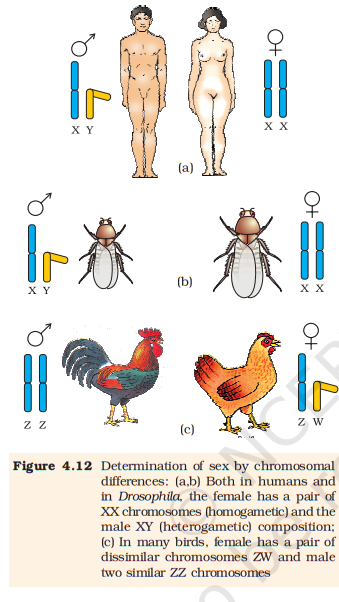
“Henking (1891) traced an ‘X body’ in insect sperm (later the X-chromosome). In XO type (e.g. grasshopper) females are XX, males are XO — male heterogamety. In XY type (humans, Drosophila) females XX, males XY — also male heterogamety. In birds, ZW females and ZZ males — female heterogamety.”

Figure 4.12 Sex determination by chromosomes (human, Drosophila, birds)
🧒 Easy Explanation

Henking spotted a mystery ‘X body’ in half the sperms — it turned out to be the X-chromosome. Different animals decide sex differently: grasshoppers (XO), humans & flies (XY males), and birds (the FEMALE is the different one — ZW).

❓ 15 NEET-style questions to master this line
  1. Who discovered the ‘X body’ (1891)?
    Show answerHenking.
  2. Grasshopper shows which type of sex determination?
    Show answerXO type.
  3. In humans and Drosophila, the male is ____ (XX/XY).
    Show answerXY (heterogametic).
  4. Birds show ____ heterogamety (ZZ male, ZW female).
    Show answerFemale.
  5. XO and XY types are both examples of ____ heterogamety.
    Show answerMale.
  6. Who first observed the 'X-body' in insect sperm?
    Show answerHenking (1891).
  7. XO type is found in?
    Show answerInsects like grasshoppers, cockroaches.
  8. Male grasshopper has how many sex chromosomes?
    Show answerOne — X (XO).
  9. Female grasshopper sex chromosomes?
    Show answerXX.
  10. XO type shows which sex as heterogametic?
    Show answerMales.
  11. XY type is found in?
    Show answerHumans, Drosophila and many mammals.
  12. ZW type is found in?
    Show answerBirds, some reptiles, and moths.
  13. In ZW type, which sex is heterogametic?
    Show answerFemales (ZW); males are ZZ.
  14. Heterogametic sex produces?
    Show answerTwo types of gametes (with different sex chromosomes).
  15. Homogametic sex produces?
    Show answerOnly one type of gamete with respect to sex chromosomes.
20

“In humans (XY type): 22 pairs of autosomes + one pair of sex chromosomes (XX female, XY male). 50% of sperm carry X and 50% carry Y; the ovum always carries X. So the sperm (father) determines the sex of the child, with a 50% chance each time.”

🧒 Easy Explanation

Humans have 23 pairs of chromosomes. The egg always carries X. Half the sperms carry X (→ girl) and half carry Y (→ boy). So it's the FATHER's sperm that decides the baby's sex — never the mother. It's wrong to blame mothers.

❓ 15 NEET-style questions to master this line
  1. Humans have how many pairs of autosomes?
    Show answer22 pairs.
  2. Female sex chromosomes: ____ ; male: ____.
    Show answerXX; XY.
  3. Which parent's gamete determines the sex of the child?
    Show answerThe father (sperm).
  4. The ovum always carries which sex chromosome?
    Show answerX.
  5. Probability of a male or female child each pregnancy?
    Show answer50% each.
  6. Total chromosomes in humans?
    Show answer46 (23 pairs).
  7. Autosome pairs in humans?
    Show answer22.
  8. Sex chromosome composition of human female?
    Show answerXX.
  9. Sex chromosome composition of human male?
    Show answerXY.
  10. Percentage of sperms carrying X?
    Show answerAbout 50%.
  11. Percentage of sperms carrying Y?
    Show answerAbout 50%.
  12. All ova are X-bearing because?
    Show answerFemales are XX and produce only X-gametes.
  13. Sex of the child is determined by?
    Show answerThe father (X- or Y-bearing sperm).
  14. Probability of having a girl with each pregnancy?
    Show answerAbout 50% (independent of previous children).
  15. Y chromosome carries which key male-determining gene?
    Show answerSRY gene.
21

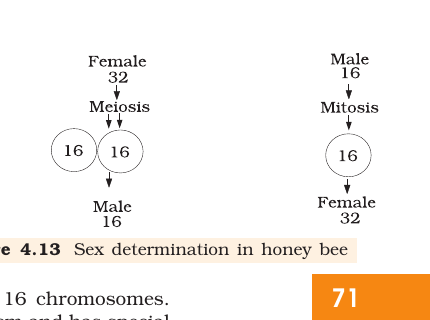
“Honey bee — haplodiploid sex determination: a fertilised egg (diploid, 32 chromosomes) develops into a female (queen/worker); an unfertilised egg (haploid, 16) develops into a male (drone) by parthenogenesis. Drones have no father and cannot have sons, but have a grandfather and can have grandsons.”

Figure 4.13 Sex determination in honey bee
🧒 Easy Explanation

Bees are weird! A fertilised egg becomes a female (queen or worker). An UNfertilised egg becomes a male (drone) — so a male bee has no father at all, only a grandfather! Females are diploid (32), males haploid (16).

❓ 15 NEET-style questions to master this line
  1. Sex determination in honey bee is called ____.
    Show answerHaplodiploid.
  2. A male honey bee (drone) develops from an ____ egg.
    Show answerUnfertilised (parthenogenesis).
  3. Female bees have ____ chromosomes; males have ____.
    Show answer32 (diploid); 16 (haploid).
  4. A drone has no ____ and cannot have ____.
    Show answerFather; sons.
  5. Males produce sperm by which division?
    Show answerMitosis.
  6. Sex determination mechanism in honey bees?
    Show answerHaplo-diploidy.
  7. Chromosome number of female honey bee?
    Show answer32 (diploid).
  8. Chromosome number of male honey bee (drone)?
    Show answer16 (haploid).
  9. Drones develop from?
    Show answerUnfertilised egg by parthenogenesis.
  10. Workers and queens develop from?
    Show answerFertilised eggs.
  11. What distinguishes a queen from a worker?
    Show answerDiet during larval stage (queen fed royal jelly).
  12. Does a drone have a father?
    Show answerNo — develops from unfertilised egg.
  13. Does a drone have a grandfather?
    Show answerYes (the queen's father).
  14. Can drones have sons?
    Show answerNo — but they can have grandsons through daughters.
  15. Type of sex determination in bees, ants, wasps?
    Show answerHaplo-diploid.
4.7

Mutation

22

“Mutation is an alteration in DNA sequence that changes genotype and phenotype. Loss (deletion) or gain (insertion/duplication) of DNA segments causes chromosomal aberrations; a change in a single base pair is a point mutation (e.g. sickle-cell anaemia). Mutagens (e.g. UV radiation) induce mutations.”

🧒 Easy Explanation

A mutation is a spelling mistake in the DNA. Big mistakes (losing or gaining chunks) are chromosomal aberrations; a tiny one-letter change is a ‘point mutation’ (which causes sickle-cell anaemia). Things that cause mutations (like UV rays) are ‘mutagens’.

❓ 15 NEET-style questions to master this line
  1. Mutation is an alteration in the ____ sequence.
    Show answerDNA.
  2. A change in a single base pair is a ____ mutation.
    Show answerPoint.
  3. Classic example of a point mutation?
    Show answerSickle-cell anaemia.
  4. Deletions/insertions of base pairs cause ____ mutations.
    Show answerFrame-shift.
  5. Agents that induce mutations are ____ (e.g. UV).
    Show answerMutagens.
  6. Define mutation.
    Show answerA heritable change in DNA sequence.
  7. Define point mutation with example.
    Show answerChange in a single base pair, e.g. sickle-cell anaemia.
  8. Define frame-shift mutation.
    Show answerInsertion or deletion of bases not in multiples of 3, shifting the reading frame.
  9. Loss/gain of chromosome segments causes?
    Show answerChromosomal aberrations.
  10. Define mutagen.
    Show answerAn agent that increases the rate of mutation.
  11. Two examples of physical mutagens?
    Show answerUV light and X-rays.
  12. Two examples of chemical mutagens?
    Show answerMustard gas and acridine dyes.
  13. Hugo de Vries proposed mutation theory using?
    Show answerOenothera lamarckiana (evening primrose).
  14. Are most mutations harmful, beneficial or neutral?
    Show answerMost are neutral or harmful; rare ones are beneficial.
  15. Sickle-cell anaemia results from which type of mutation?
    Show answerSubstitution point mutation (GAG → GUG in β-globin gene).
4.8

Genetic Disorders

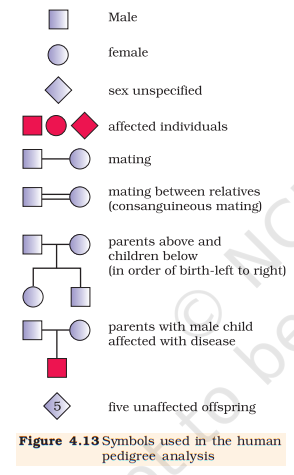
23

“Pedigree analysis studies the inheritance of a trait across generations of a family using standard symbols (since controlled crosses aren't possible in humans).”

Figure 4.13 Symbols used in pedigree analysis
🧒 Easy Explanation

We can't do breeding experiments on people, so geneticists draw a family tree (a ‘pedigree’) using special symbols to follow a trait — like colour blindness — through the generations.

❓ 15 NEET-style questions to master this line
  1. Study of a trait across family generations is ____.
    Show answerPedigree analysis.
  2. Why is pedigree analysis used in humans?
    Show answerControlled crosses are not possible in humans.
  3. In pedigree symbols, a circle represents a ____ and a square a ____.
    Show answerFemale; male.
  4. A filled/shaded symbol represents an ____ individual.
    Show answerAffected.
  5. Pedigree analysis can reveal whether a trait is dominant or ____.
    Show answerRecessive.
  6. What is a pedigree chart?
    Show answerA diagram showing inheritance of a trait through several generations of a family.
  7. Why is pedigree analysis used in humans?
    Show answerBecause controlled crosses (like in pea) are impossible/unethical.
  8. How is a male represented in a pedigree?
    Show answerSquare.
  9. How is a female represented?
    Show answerCircle.
  10. How are affected individuals shown?
    Show answerFilled (shaded) symbol.
  11. Horizontal line between two symbols means?
    Show answerMarriage / mating.
  12. Vertical line from a couple leads to?
    Show answerTheir offspring.
  13. Symbol for carriers in a pedigree?
    Show answerHalf-filled (dotted) circle / square.
  14. Identical twins are shown as?
    Show answerTwo symbols joined by triangles converging at a common point.
  15. A trait that skips a generation is likely?
    Show answerRecessive (or sex-linked recessive).
24

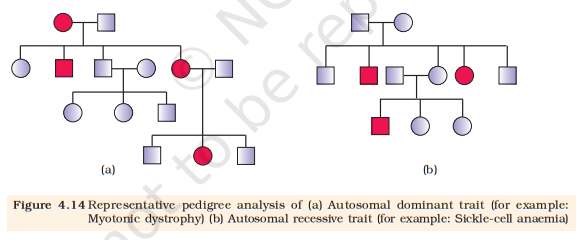
“Mendelian disorders are caused by mutation/alteration in a single gene (e.g. haemophilia, cystic fibrosis, sickle-cell anaemia, colour blindness, phenylketonuria, thalassemia) and may be dominant or recessive, sometimes sex-linked.”

Figure 4.14 Pedigrees: (a) autosomal dominant (b) autosomal recessive
🧒 Easy Explanation

Some diseases come from just ONE faulty gene — these are ‘Mendelian disorders’, like haemophilia, sickle-cell anaemia and colour blindness. They can be dominant or recessive, and some are carried on the sex chromosome.

❓ 15 NEET-style questions to master this line
  1. Disorders caused by a single-gene defect are ____ disorders.
    Show answerMendelian.
  2. Name two Mendelian disorders.
    Show answerHaemophilia, sickle-cell anaemia, colour blindness, PKU, thalassemia (any two).
  3. Mendelian disorders may be dominant or ____.
    Show answerRecessive.
  4. Which Mendelian disorder is sex-linked recessive (clotting)?
    Show answerHaemophilia.
  5. Pattern of inheritance of Mendelian disorders is traced by ____.
    Show answerPedigree analysis.
  6. Define Mendelian disorder.
    Show answerA disorder caused by mutation/alteration in a single gene.
  7. Two autosomal recessive Mendelian disorders?
    Show answerCystic fibrosis, sickle-cell anaemia.
  8. Two X-linked recessive Mendelian disorders?
    Show answerHaemophilia and colour blindness.
  9. Is autosomal dominant disorder more visible than recessive?
    Show answerYes — appears in every generation.
  10. Sex-linked recessive disorders affect mainly which sex?
    Show answerMales (only one X chromosome).
  11. Can females be carriers of X-linked recessive disorders?
    Show answerYes — XX heterozygotes are unaffected carriers.
  12. Which Mendelian disorder is autosomal dominant?
    Show answerMyotonic dystrophy (also Huntington's disease).
  13. Why are X-linked disorders rare in females?
    Show answerFemales need both X chromosomes to carry the recessive allele.
  14. Pedigree of an X-linked recessive trait shows?
    Show answerMostly affected males, no male-to-male transmission.
  15. Two key features for autosomal recessive disorders?
    Show answerSkip generations; both parents must be carriers.
25

“Colour blindness is an X-linked recessive defect (red/green discrimination), occurring in ~8% of males but only ~0.4% of females. Haemophilia is X-linked recessive (defective blood clotting); a carrier female transmits it to sons (e.g. Queen Victoria's pedigree).”

🧒 Easy Explanation

Colour blindness and haemophilia ride on the X-chromosome and are recessive. Boys (one X) are affected far more than girls (two X). A mother can be a ‘carrier’ (healthy herself) but pass it to her sons — famously in Queen Victoria's family.

❓ 15 NEET-style questions to master this line
  1. Colour blindness is a ____-linked recessive disorder.
    Show answerX.
  2. Colour blindness occurs in about ____ % of males.
    Show answer8% (vs 0.4% of females).
  3. Why are males more often colour blind?
    Show answerMales have only one X chromosome.
  4. Haemophilia affects which body process?
    Show answerBlood clotting.
  5. A carrier female transmits haemophilia to her ____.
    Show answerSons.
  6. Mode of inheritance of red-green colour blindness?
    Show answerX-linked recessive.
  7. Percentage of men affected by colour blindness?
    Show answerAbout 8%.
  8. Percentage of women affected by colour blindness?
    Show answerAbout 0.4%.
  9. Why is colour blindness more common in men?
    Show answerSingle X chromosome — any recessive allele is expressed.
  10. Haemophilia is also called?
    Show answerBleeder's disease / Christmas disease (Haemophilia B).
  11. Defective clotting factor in classical haemophilia A?
    Show answerFactor VIII.
  12. Carrier mother + normal father → probability of haemophilic son?
    Show answer50%.
  13. Famous historical pedigree of haemophilia?
    Show answerQueen Victoria's family.
  14. Why doesn't a man transmit haemophilia to his son?
    Show answerSons get the father's Y chromosome, not X.
  15. Daughter of a haemophilic father is a?
    Show answerCarrier (heterozygous).
26

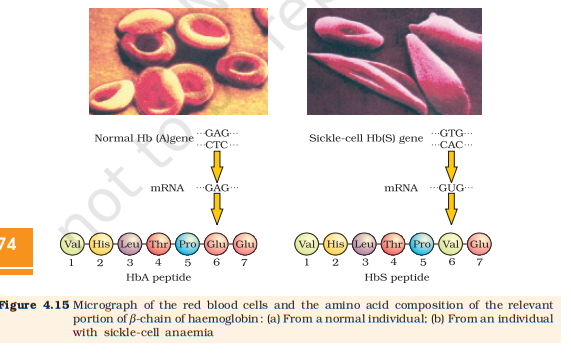
“Sickle-cell anaemia is an autosomal recessive disorder (alleles HbA, HbS); only homozygous HbSHbS shows disease, HbAHbS are carriers. It is a point mutation: GAG→GUG replaces Glutamic acid by Valine at the 6th position of the β-globin chain.”

Figure 4.15 Sickle-cell anaemia — RBC & β-chain
🧒 Easy Explanation

Sickle-cell anaemia comes from a one-letter DNA change that swaps a single building block (Glutamic acid → Valine) in the blood protein. Only people with two faulty copies (HbSHbS) get the disease; those with one are healthy ‘carriers’.

❓ 15 NEET-style questions to master this line
  1. Sickle-cell anaemia is ____ (autosomal/sex-linked) recessive.
    Show answerAutosomal.
  2. Which genotype shows the disease?
    Show answerHbSHbS (homozygous).
  3. HbAHbS individuals are ____.
    Show answerCarriers (sickle-cell trait).
  4. The amino-acid substitution is ____ → ____ at position 6 of β-globin.
    Show answerGlutamic acid → Valine.
  5. The codon change responsible is ____.
    Show answerGAG → GUG.
  6. Mode of inheritance of sickle-cell anaemia?
    Show answerAutosomal recessive.
  7. Affected genotype?
    Show answerHb^S Hb^S.
  8. Carrier genotype?
    Show answerHb^A Hb^S.
  9. Mutation type causing sickle-cell?
    Show answerPoint mutation (GAG → GUG).
  10. Amino acid replacement in sickle-cell haemoglobin?
    Show answerGlutamic acid → Valine at the 6th position of β-globin chain.
  11. Why does the red cell sickle?
    Show answerHbS polymerises under low O₂ conditions, distorting the RBC.
  12. Geographic regions where sickle-cell is common?
    Show answerSub-Saharan Africa, India, Mediterranean regions.
  13. Why is the HbS allele selected in malarial regions?
    Show answerHeterozygotes have some resistance to malaria (heterozygote advantage).
  14. Sickled cells block?
    Show answerCapillaries, causing pain and tissue damage.
  15. Which globin gene chain is affected?
    Show answerβ-globin.
27

“Thalassemia is an autosomal recessive disorder — a quantitative defect in synthesising globin chains (α-thalassemia: genes HBA1/HBA2 on chr 16; β-thalassemia: gene HBB on chr 11). It differs from sickle-cell anaemia, which is a qualitative defect. Phenylketonuria is autosomal recessive (lacks phenylalanine hydroxylase → mental retardation).”

🧒 Easy Explanation

Thalassemia means the body makes TOO FEW good globin chains (a ‘how-much’ problem). Sickle-cell makes a WRONG chain (a ‘which-kind’ problem). Phenylketonuria is another recessive disorder where a missing enzyme harms the brain.

❓ 15 NEET-style questions to master this line
  1. Thalassemia is a ____ defect of globin synthesis (quantitative/qualitative).
    Show answerQuantitative.
  2. Sickle-cell anaemia is a ____ defect.
    Show answerQualitative.
  3. β-thalassemia involves gene ____ on chromosome 11.
    Show answerHBB.
  4. α-thalassemia involves genes HBA1/HBA2 on chromosome ____.
    Show answer16.
  5. Phenylketonuria patients lack the enzyme ____.
    Show answerPhenylalanine hydroxylase.
  6. Mode of inheritance of thalassaemia?
    Show answerAutosomal recessive.
  7. α-thalassaemia is caused by mutations in which gene(s)?
    Show answerHBA1 and/or HBA2 on chromosome 16.
  8. β-thalassaemia is caused by mutations in which gene?
    Show answerHBB on chromosome 11.
  9. Quantitative or qualitative defect — thalassaemia?
    Show answerQuantitative — reduced amount of a globin chain.
  10. Quantitative or qualitative defect — sickle-cell anaemia?
    Show answerQualitative — abnormal haemoglobin synthesised.
  11. How is α-thalassaemia treated/managed?
    Show answerRepeated blood transfusions, iron chelation.
  12. Major symptom of β-thalassaemia?
    Show answerSevere anaemia from early infancy (Cooley's anaemia).
  13. PKU stands for?
    Show answerPhenylketonuria.
  14. Mode of inheritance of PKU?
    Show answerAutosomal recessive.
  15. Enzyme deficient in PKU?
    Show answerPhenylalanine hydroxylase.
28

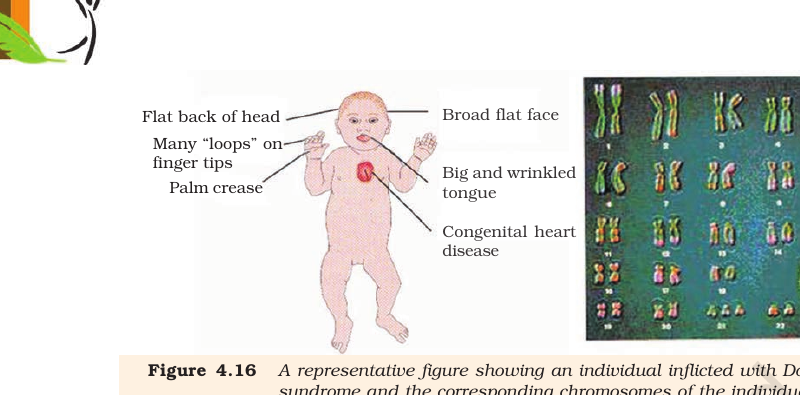
“Chromosomal disorders are caused by absence/excess/abnormal arrangement of chromosomes. Aneuploidy (gain/loss of a chromosome) — Down's syndrome = trisomy of 21 (47 chromosomes); Turner's syndrome = loss of an X (45, XO). Polyploidy = gain of a whole chromosome set (common in plants).”

Figure 4.16 Down's syndrome & karyotype
🧒 Easy Explanation

Sometimes whole chromosomes are gained or lost. Down's syndrome = one EXTRA chromosome 21 (so 47 total). Turner's = one X MISSING (45, X0). Gaining a whole extra SET is polyploidy (common in plants).

❓ 15 NEET-style questions to master this line
  1. Gain or loss of a chromosome is called ____.
    Show answerAneuploidy.
  2. Down's syndrome is trisomy of chromosome ____.
    Show answer21 (total 47).
  3. Turner's syndrome karyotype is ____.
    Show answer45, X0 (loss of an X).
  4. Gain of a whole chromosome set is ____.
    Show answerPolyploidy.
  5. Down's syndrome was first described by ____ (1866).
    Show answerLangdon Down.
  6. Define aneuploidy.
    Show answerGain or loss of one or a few chromosomes (e.g. trisomy or monosomy).
  7. Define polyploidy.
    Show answerGain of one or more whole sets of chromosomes (3n, 4n, …).
  8. Chromosome number in Down's syndrome?
    Show answer47 (extra chromosome 21).
  9. Down's syndrome is also called?
    Show answerTrisomy 21.
  10. Karyotype of Turner's syndrome?
    Show answer45, XO.
  11. Phenotype of Turner's syndrome?
    Show answerSterile female with short stature, webbed neck, rudimentary ovaries, lack of secondary sex characters.
  12. Common cause of aneuploidy?
    Show answerNon-disjunction during meiosis.
  13. Polyploidy is mainly seen in?
    Show answerPlants (wheat, cotton, banana).
  14. Risk factor for Down's syndrome?
    Show answerAdvanced maternal age.
  15. Phenotypic features of Down's syndrome?
    Show answerShort stature, flat face, broad palms with a single crease, intellectual disability.
29

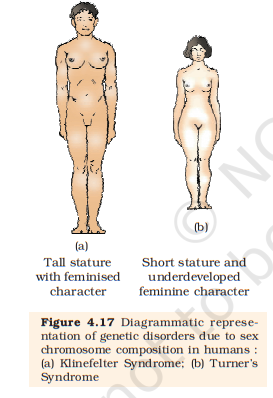
“Klinefelter's syndrome: an extra X-chromosome (47, XXY) — overall masculine but with gynaecomastia (breast development); such individuals are sterile. Turner's syndrome: 45, X0 — sterile females with rudimentary ovaries and lack of secondary sexual characters.”

Figure 4.17 (a) Klinefelter (b) Turner syndrome
🧒 Easy Explanation

Klinefelter's: a boy with an extra X (XXY) — mostly male but with some female features (breast development) and sterile. Turner's: a girl missing an X (X0) — short, sterile, with underdeveloped features.

❓ 15 NEET-style questions to master this line
  1. Klinefelter's syndrome karyotype is ____.
    Show answer47, XXY.
  2. Breast development in Klinefelter's is called ____.
    Show answerGynaecomastia.
  3. Klinefelter and Turner individuals are both ____.
    Show answerSterile.
  4. Turner's syndrome karyotype is ____.
    Show answer45, X0.
  5. Turner's females have ____ ovaries.
    Show answerRudimentary.
  6. Karyotype of Klinefelter's syndrome?
    Show answer47, XXY.
  7. Klinefelter's individual is phenotypically?
    Show answerMale — but with feminine features (gynaecomastia).
  8. Define gynaecomastia.
    Show answerDevelopment of breast tissue in males.
  9. Are Klinefelter's individuals fertile?
    Show answerGenerally no — sterile.
  10. Karyotype of Turner's syndrome?
    Show answer45, X0.
  11. Is a Turner's individual male or female?
    Show answerFemale (phenotypically) but sterile.
  12. Turner's syndrome ovaries are?
    Show answerRudimentary (streak gonads).
  13. Cause of both Klinefelter's and Turner's syndromes?
    Show answerNon-disjunction of sex chromosomes during meiosis.
  14. Klinefelter's vs Down's — chromosomal difference?
    Show answerKlinefelter's: extra sex chromosome; Down's: extra autosome (21).
  15. Treatment for Klinefelter's?
    Show answerTestosterone replacement therapy to develop masculine features.
⚖️

Comparison Tables for NEET

28 high-yield comparison tables covering every confusion point of this chapter. Use these for last-minute revision — each one packs a typical NEET MCQ into one row.

1. Genotype vs Phenotype

The very first vocabulary trap in genetics MCQs.

FeatureGenotypePhenotype
DefinitionThe genetic make-up (alleles present)The observable appearance / character
SymbolTT, Tt, ttTall, dwarf
Determined byInheritance onlyGenotype + environment
Changes with environment?NoYes (e.g. nutrition affects height)
Example (pea)TtTall

2. Homozygous vs Heterozygous

FeatureHomozygousHeterozygous
AllelesIdentical (TT or tt)Different (Tt)
Gamete typesOne type (T or t)Two types (T and t)
Breeds true on selfing?YesNo
Phenotype possibilitiesDominant or recessiveDominant (or intermediate)
Test-cross resultUniform offspring1 : 1 ratio

3. Dominant vs Recessive

FeatureDominant alleleRecessive allele
Expression in heterozygoteAlways expressedMasked
Symbol conventionCapital letter (T)Small letter (t)
Appears in F1?Yes (always)No
Appears in F2?3/4 of plants1/4 of plants
Example in peaTall, round, yellowDwarf, wrinkled, green

4. Monohybrid vs Dihybrid Cross

FeatureMonohybridDihybrid
Genes followedOneTwo
Gametes from F1Two types (T, t)Four types (RY, Ry, rY, ry)
F2 phenotypic ratio3 : 19 : 3 : 3 : 1
F2 genotypic ratio1 : 2 : 11:2:1:2:4:2:1:2:1 (9 classes)
Verifies law ofSegregationIndependent assortment
Pea exampleTall × DwarfRound-yellow × Wrinkled-green

5. Test Cross vs Back Cross

Frequently confused — every back cross is not a test cross.

FeatureTest crossBack cross
Crossed withHomozygous recessive parentEither of the parents
PurposeDetermine genotype of dominant individualRecover parental phenotype / general study
Specific?A specific kind of back crossGeneral term
Result if Tt × tt1 tall : 1 dwarfSame — also a test cross here
Result if Tt × TTNot a test crossAll tall (back cross only)

6. F1 vs F2 Generation

FeatureF1 generationF2 generation
SourceP1 × P2 crossF1 × F1 (self or sibling)
Genotype (monohybrid)All Tt (uniform)1 TT : 2 Tt : 1 tt
PhenotypeAll show dominant trait3 : 1 dominant : recessive
Heterozygosity100%50%
Recessive traitHiddenReappears

7. Complete Dominance vs Incomplete Dominance vs Co-dominance ★

The single most asked comparison from this chapter.

FeatureComplete dominanceIncomplete dominanceCo-dominance
F1 phenotypeSame as dominant parentIntermediate (blended)Both parental phenotypes seen
F2 phenotypic ratio3 : 11 : 2 : 11 : 2 : 1
F2 genotypic ratio1 : 2 : 11 : 2 : 11 : 2 : 1
Phenotype = Genotype ratio?No (3:1 vs 1:2:1)Yes (1:2:1 = 1:2:1)Yes (1:2:1 = 1:2:1)
Allele expression in heterozygoteOnly dominantBoth partially blendedBoth fully and separately
ExampleTall × Dwarf peaAntirrhinum (red × white → pink)ABO blood group (IA IB = AB)

8. Mendelian vs Non-Mendelian Inheritance

FeatureMendelianNon-Mendelian
Follows 3:1 / 9:3:3:1?YesNo (deviates)
Number of genesUsually one or twoMay be several
Dominance patternComplete dominanceIncomplete / co-dominance / linkage / polygenic
Environment effectMinimalOften significant
ExamplePea heightSkin colour, ABO blood, linked traits

9. Multiple Alleles vs Pleiotropy

One gene, many alleles vs one gene, many traits.

FeatureMultiple allelesPleiotropy
DefinitionA gene with more than two allelic forms in a populationA single gene affecting multiple unrelated traits
Genes involvedOne gene; ≥ 3 alleles in populationOne gene; one product but many effects
Number of phenotypes affectedOne character with many variantsSeveral different characters
Number of alleles per individualOnly two (diploid)Two (usual)
ExampleABO blood group (IA, IB, i)Phenylketonuria; sickle-cell anaemia

10. Mendel's Three Laws — Side by Side

FeatureLaw of DominanceLaw of SegregationLaw of Independent Assortment
OrderFirst lawSecond lawThird law
StatementIn a heterozygote, one allele dominates the otherTwo alleles of a gene separate during gamete formationAlleles of different genes assort independently of one another
Cytological basisDominance of one allele's productSeparation of homologous chromosomes (Anaphase I)Random orientation of bivalents (Metaphase I)
Cross verified byMonohybrid F1Monohybrid F2 (3:1)Dihybrid F2 (9:3:3:1)
ExceptionIncomplete & co-dominanceRare (e.g. meiotic drive)Linkage of genes on same chromosome

11. Linkage vs Independent Assortment

FeatureLinkageIndependent assortment
Gene locationSame chromosomeDifferent chromosomes
Inheritance patternInherited togetherInherited independently
F2 ratioDeviates from 9:3:3:19 : 3 : 3 : 1
Recombination frequencyLess than 50%Approx 50%
Established byT. H. Morgan (Drosophila)Mendel (pea)

12. Linkage vs Crossing Over

FeatureLinkageCrossing over
DefinitionTendency of genes on the same chromosome to be inherited togetherExchange of segments between non-sister chromatids of homologous chromosomes
Effect on inheritanceKeeps parental combinationsProduces recombinants
Site / eventSame chromosomeProphase I (pachytene)
Frequency increases withCloseness of genesDistance between genes
Outcome of offspringParental combinations dominateNew (recombinant) combinations

13. XX/XY vs XX/XO vs ZZ/ZW vs Haplodiploid

TypeHeterogametic sexFemale chromosomesMale chromosomesExamples
XY typeMaleXXXYHumans, Drosophila
XO typeMaleXXXO (one X only)Grasshopper, cockroach
ZW typeFemaleZWZZBirds, some reptiles, moths
HaplodiploidyMales are haploidDiploidHaploid (from unfertilised eggs)Honey bees, ants, wasps

14. Male vs Female Heterogamety

FeatureMale heterogametyFemale heterogamety
Heterogametic sexMaleFemale
Male gametesTwo types (X and Y, or X and 0)One type (Z only)
Female gametesOne type (X only)Two types (Z and W)
Sex determined bySperm (father)Egg (mother)
ExamplesMammals (incl. humans), Drosophila, grasshopperBirds, moths, butterflies, some fish

15. Mendelian vs Chromosomal Disorders

FeatureMendelian disordersChromosomal disorders
CauseMutation in a single geneLoss/gain/rearrangement of chromosomes
InheritanceFollows Mendel's lawsUsually not inherited; sporadic
DetectionPedigree analysisKaryotype analysis
ModeDominant or recessive; autosomal or sex-linkedAneuploidy or polyploidy
ExamplesHaemophilia, sickle-cell, PKU, thalassaemia, colour blindnessDown's, Klinefelter's, Turner's syndromes

16. Autosomal vs Sex-Linked Disorders

FeatureAutosomal disorderSex-linked (X-linked) disorder
Gene locationAutosomes (1–22)X chromosome
Sex ratio of affectedRoughly equal in both sexesPredominantly males
Female carriers possible?Yes (heterozygous carriers)Yes (heterozygous XᴬXᵃ)
Father-to-son transmission?YesNo (Y doesn't carry the allele)
ExamplesSickle-cell anaemia, thalassaemia, PKUHaemophilia, colour blindness, Duchenne MD

17. Autosomal Dominant vs Autosomal Recessive

FeatureAutosomal dominantAutosomal recessive
Number of mutant alleles neededOneTwo
Appears in every generation?YesNo — may skip generations
Frequency in heterozygotesAffectedCarriers (unaffected)
Both parents must be affected?Often only oneUsually both carriers
ExamplesHuntington's disease, Myotonic dystrophySickle-cell anaemia, PKU, cystic fibrosis

18. Sickle-Cell Anaemia vs Thalassaemia

Two β-globin disorders that look similar — but the mechanism is opposite.

FeatureSickle-cell anaemiaThalassaemia
Defect typeQualitative (faulty haemoglobin)Quantitative (less haemoglobin made)
MutationPoint mutation (GAG → GUG)Deletion or splice-site mutations
Amino acid changeGlutamic acid → Valine (position 6 of β-chain)No amino-acid substitution; lower chain synthesis
Chain affectedβ-globin (always)α (HBA1/HBA2) or β (HBB)
InheritanceAutosomal recessiveAutosomal recessive
RBC morphologySickle-shaped under low O₂Small, pale (microcytic, hypochromic)
Heterozygote advantageResistance to malariaResistance to falciparum malaria

19. α-thalassaemia vs β-thalassaemia

Featureα-thalassaemiaβ-thalassaemia
Chain underproducedα-globin chainβ-globin chain
Genes involvedHBA1 and HBA2HBB
Chromosome1611
Severity depends onHow many of 4 α-gene copies are affectedWhether homozygous or heterozygous for HBB mutation
Common inSouth-East Asia, MediterraneanMediterranean, Middle East, India

20. Haemophilia vs Colour Blindness

Both X-linked recessive — but the consequences are very different.

FeatureHaemophiliaColour blindness
Defective productClotting factor VIII (A) or IX (B)Cone pigment (red or green opsin)
InheritanceX-linked recessiveX-linked recessive
% affected malesAbout 1 in 5000–10,000About 8%
% affected femalesVery rare (XᴴXᴴ would be lethal in utero)About 0.4%
Famous pedigreeQueen Victoria's descendantsCommon in NEET as 'sex-linked' example
Carrier transmits toSons (50% affected); daughters (50% carriers)Sons (50% affected); daughters (50% carriers)

21. Down's vs Klinefelter's vs Turner's Syndrome

All three are aneuploidies — but they differ in karyotype and consequences.

FeatureDown's syndromeKlinefelter's syndromeTurner's syndrome
Karyotype47, +21 (trisomy 21)47, XXY45, X0
TypeAutosomal aneuploidySex-chromosome aneuploidySex-chromosome aneuploidy
Phenotypic sexEitherMaleFemale
FertilityUsually reduced (often sterile)SterileSterile
Key featuresShort stature, flat face, single palmar crease, intellectual disabilityTall, gynaecomastia, sparse body hair, sterileShort stature, webbed neck, rudimentary ovaries, lack of secondary sex characters
CauseNon-disjunction of chromosome 21Non-disjunction of X chromosomesLoss of one X chromosome

22. Aneuploidy vs Polyploidy

FeatureAneuploidyPolyploidy
DefinitionGain or loss of one (or a few) chromosome(s)Gain of one or more whole sets of chromosomes
Chromosome number changes by± 1, ± 2 …n at a time (3n, 4n, …)
Common inAnimals (humans)Plants (wheat, cotton, banana)
Effects in humansOften severe (syndromes)Almost always lethal
ExampleDown's (47, +21), Turner's (45, X0)Triploid banana (3n), hexaploid wheat (6n)

23. Mitosis vs Meiosis (in inheritance context)

FeatureMitosisMeiosis
Occurs inSomatic cellsGerm cells
Daughter cellsTwoFour
Chromosome numberMaintained (2n → 2n)Halved (2n → n)
Crossing overAbsentPresent (pachytene)
Genetic variationNone (clonal)Yes — segregation + independent assortment + crossing over
Relevance to geneticsGrowth, repairSource of Mendelian ratios and genetic variation

24. Spermatogenesis vs Oogenesis

FeatureSpermatogenesisOogenesis
SiteSeminiferous tubules of testisOvary
Begins atPubertyFoetal life
Number of functional products per primary cellFour spermsOne ovum + 2–3 polar bodies
Division of cytoplasmEqualUnequal (saves cytoplasm for the ovum)
DurationContinuous through adult lifeCyclic; arrested in prophase-I from birth
Hormonal controlFSH (Sertoli) + LH (Leydig)FSH + LH + estrogen, progesterone

25. Incomplete Dominance vs Co-dominance

The most-confused trap pair. Both show 1:2:1 F2, but the heterozygote is what matters.

FeatureIncomplete dominanceCo-dominance
Expression in heterozygoteIntermediate (blended look)Both alleles expressed fully, side by side
F2 phenotypic ratio1 : 2 : 11 : 2 : 1
F2 genotypic ratio1 : 2 : 1 (same as phenotypic)1 : 2 : 1 (same as phenotypic)
Identifiable allele products?Blended single productBoth products distinctly identifiable
ExamplesAntirrhinum (red × white → pink); Mirabilis jalapaABO blood (IᴬIᴮ = AB); MN blood group

26. Mendelian vs Polygenic Inheritance

FeatureMendelian inheritancePolygenic inheritance
Number of genesOne or twoThree or more
Allele effectsDiscrete (dominant / recessive)Additive (each contributes a little)
Phenotype distributionDiscrete classes (3:1, 9:3:3:1)Continuous (bell-shaped curve)
Environmental influenceMinorMajor
ExamplesPea height, ABO blood groupSkin colour, human height, yield

27. Locus vs Allele vs Gene

Three close cousins — distinguished often in single-line MCQs.

FeatureGeneAlleleLocus
DefinitionFunctional unit of heredity (sequence of DNA coding a product)Alternative form of a geneSpecific position of a gene on a chromosome
What it representsWhat the gene doesVariations of that geneWhere the gene is
ExampleGene for ABO blood group (I)Iᴬ, Iᴮ, iLong arm of chromosome 9
Number per organism (per gene)OneTwo (in diploids)One per gene

28. Mutation vs Recombination

Both create variation — but through entirely different means.

FeatureMutationRecombination
Source of new variationYes (introduces new alleles)Yes (shuffles existing alleles)
MechanismChange in DNA sequenceCrossing over between homologous chromosomes
ScaleSingle base (point) to whole chromosomeChromosomal segments
Heritable?Yes (if in germ line)Yes (occurs in meiosis)
When occursRandom, can occur anytimeProphase I of meiosis
Example outcomeSickle-cell allele HbS from HbANew chromosomal combinations from parental ones

Exceptions to Remember

🧪

Scientists

Gregor Mendel

‘Father of Genetics’. Pea experiments (1856–63) → Laws of Dominance, Segregation & Independent Assortment.

Reginald C. Punnett

Devised the Punnett square to predict offspring genotypes.

de Vries, Correns & von Tschermak

Independently rediscovered Mendel's work in 1900.

Walter Sutton & Theodore Boveri

Proposed the Chromosomal Theory of Inheritance (1902).

Thomas Hunt Morgan

Verified the chromosomal theory using Drosophila; discovered linkage & recombination.

Alfred Sturtevant

First to map genes using recombination frequency.

Henking

Discovered the ‘X body’ (1891), later the X-chromosome.

Langdon Down

First described Down's syndrome (1866).

Watson & Crick

Proposed the DNA double helix (1953) — chapter intro context.

📌

Examples Given in the Chapter

ExampleSignificance
Pisum sativum (garden pea)Mendel's experimental plant — 7 contrasting traits.
Antirrhinum (snapdragon)Incomplete dominance (red × white → pink).
Human ABO blood groupsCo-dominance & multiple alleles (gene I).
Pea starch gene (B/b)Dominance depends on the phenotype examined.
Drosophila melanogasterMorgan's linkage/recombination & XY sex determination.
GrasshopperXO type sex determination (male heterogamety).
BirdsZW/ZZ — female heterogamety.
Honey beeHaplodiploid sex determination.
Human skin colour & heightPolygenic (additive) traits.
PhenylketonuriaPleiotropy (one gene, many effects).
Sahiwal cowArtificial selection / domestication.
Queen Victoria's pedigreeHaemophilia (X-linked recessive).
📝

NCERT Exercises — Explained & Answered

Q1Advantages of selecting the pea plant for Mendel's experiments.

🧒 What it’s really asking

Why was the humble pea a perfect choice?

Show answer
Pea has many true-breeding varieties, clear contrasting traits, is normally self-pollinating (easy to maintain pure lines) yet can be artificially cross-pollinated, has a short life cycle and produces many offspring.

Q2Differentiate: (a) Dominance vs Recessive (b) Homozygous vs Heterozygous (c) Monohybrid vs Dihybrid.

🧒 What it’s really asking

Tell apart these basic genetics word-pairs.

Show answer
(a) Dominant allele expresses in the heterozygote; recessive is masked. (b) Homozygous = two identical alleles (TT/tt); heterozygous = two different (Tt). (c) Monohybrid cross = one character; dihybrid = two characters.

Q3A diploid organism is heterozygous for 4 loci — how many gamete types?

🧒 What it’s really asking

How many different gametes from 4 ‘mixed’ gene pairs?

Show answer
Number of gamete types = 2ⁿ = 2⁴ = 16.

Q4Explain the Law of Dominance using a monohybrid cross.

🧒 What it’s really asking

Use the tall × dwarf cross to show one trait masking the other.

Show answer
Tall (TT) × dwarf (tt) → F1 all Tt = tall (T masks t = Law of Dominance). Self-cross F1 → F2 = 3 tall : 1 dwarf; both traits reappear, the dwarf only when homozygous (tt).

Q5Define and design a test cross.

🧒 What it’s really asking

How do you find a hidden genotype?

Show answer
A test cross crosses an individual of dominant phenotype (unknown genotype) with the homozygous recessive. E.g. Tt × tt → 1 tall : 1 dwarf (reveals heterozygote); TT × tt → all tall.

Q6Punnett square: cross of a homozygous female × heterozygous male for one locus — F1 distribution.

🧒 What it’s really asking

What do the babies look like from AA × Aa?

Show answer
AA × Aa → gametes A, A × A, a → offspring 1 AA : 1 Aa, i.e. all show the dominant phenotype (100% dominant; genotypically 1:1).

Q7TtYy (tall, yellow… here tall green) × Ttyy — proportion of (a) tall & green (b) dwarf & green.

🧒 What it’s really asking

A two-gene cross — work out two specific offspring fractions.

Show answer
Split per gene. Tt × Tt → ¾ tall, ¼ dwarf. Yy × yy → ½ yellow, ½ green. (a) tall & green = ¾ × ½ = 3/8. (b) dwarf & green = ¼ × ½ = 1/8.

Q8If two loci in a dihybrid cross are linked, what is the F1/F2 distribution?

🧒 What it’s really asking

What happens to 9:3:3:1 when the genes are stuck together?

Show answer
If genes are linked, they tend to be inherited together, so parental combinations dominate and the ratio deviates from 9:3:3:1 (recombinants are far fewer).

Q9Contribution of T.H. Morgan to genetics.

🧒 What it’s really asking

What did the fruit-fly scientist give us?

Show answer
Morgan experimentally verified the chromosomal theory using Drosophila, discovered linkage and recombination, and (with Sturtevant) laid the basis for gene mapping.

Q10What is pedigree analysis and how is it useful?

🧒 What it’s really asking

Why do geneticists draw family trees?

Show answer
Pedigree analysis traces a trait through generations of a family using standard symbols. It helps decide if a trait is dominant/recessive or autosomal/sex-linked, and to predict the risk of a disorder in offspring.

Q11How is sex determined in human beings?

🧒 What it’s really asking

What decides if a baby is a boy or a girl?

Show answer
Humans are XY type: females XX, males XY (+22 autosome pairs). The ovum is always X; 50% of sperm are X, 50% Y. An X-sperm → girl (XX), a Y-sperm → boy (XY). So the father determines the sex.

Q12A child is blood group O; father A, mother B — work out the parents' genotypes and possible children.

🧒 What it’s really asking

How can an A father and B mother have an O child?

Show answer
For an O (ii) child, each parent must carry an i. So father = IAi, mother = IBi. Their children can be AB (IAIB), A (IAi), B (IBi) or O (ii) — a 1:1:1:1 ratio.

Q13Explain with examples: (a) Co-dominance (b) Incomplete dominance.

🧒 What it’s really asking

Two ‘not-simple-dominance’ patterns.

Show answer
(a) Co-dominance: both alleles express fully — e.g. AB blood group (IA & IB). (b) Incomplete dominance: heterozygote is intermediate — e.g. pink snapdragon (Rr) from red × white; F2 = 1:2:1.

Q14What is point mutation? Give one example.

🧒 What it’s really asking

What's a one-letter DNA change?

Show answer
A point mutation is a change in a single base pair of DNA. Example: sickle-cell anaemia (GAG→GUG, Glu→Val at position 6 of β-globin).

Q15Who proposed the chromosomal theory of inheritance?

🧒 What it’s really asking

Name the scientists.

Show answer
Walter Sutton and Theodore Boveri (1902).

Q16Mention any two autosomal genetic disorders with their symptoms.

🧒 What it’s really asking

Two single-gene diseases not on the sex chromosome.

Show answer
Sickle-cell anaemia (autosomal recessive — sickle-shaped RBCs, anaemia) and Phenylketonuria (autosomal recessive — mental retardation, reduced pigmentation). [Also thalassemia, cystic fibrosis.]

High-Yield Points (Last-Minute Revision)

  1. Monohybrid F2: phenotype 3:1, genotype 1:2:1. Dihybrid F2: 9:3:3:1. Test cross: 1:1.
  2. Mendel's 3 laws: Dominance, Segregation (always true), Independent Assortment (fails for linked genes).
  3. Incomplete dominance F2 = 1:2:1 (= genotypic ratio); Co-dominance = AB blood group.
  4. ABO genotypes: A=IAIA/IAi · B=IBIB/IBi · AB=IAIB · O=ii. (6 genotypes, 4 phenotypes).
  5. n heterozygous loci → 2ⁿ gamete types (e.g. 4 loci → 16).
  6. Punnett square = Reginald Punnett. Chromosomal theory = Sutton & Boveri (1902).
  7. Morgan = Drosophila, linkage & recombination; Sturtevant = gene mapping (recombination frequency = distance).
  8. Sex determination: XY (humans/Drosophila, male heterogamety), XO (grasshopper), ZW (birds, female heterogamety).
  9. Honey bee = haplodiploid: female 2n=32, male n=16 (parthenogenesis); drone has no father.
  10. Point mutation → sickle-cell (GAG→GUG, Glu→Val, 6th position β-globin). Frame-shift = insertion/deletion.
  11. X-linked recessive: colour blindness (8% M, 0.4% F), haemophilia.
  12. Autosomal recessive: sickle-cell, thalassemia, phenylketonuria, cystic fibrosis. Sickle = qualitative, thalassemia = quantitative.
  13. Chromosomal disorders: Down's = trisomy 21 (47), Klinefelter = XXY (47), Turner = X0 (45).
  14. Aneuploidy = gain/loss of a chromosome (non-disjunction); Polyploidy = extra whole set (plants).
🏆

100 Practice Questions — PYQ + Infinity Bank

75 NEET/AIPMT PYQs + 25 Infinity questions — each with options, a plain explanation and the answer. The badge shows the topic and the exam year (or 'Infinity' for the practice bank).